
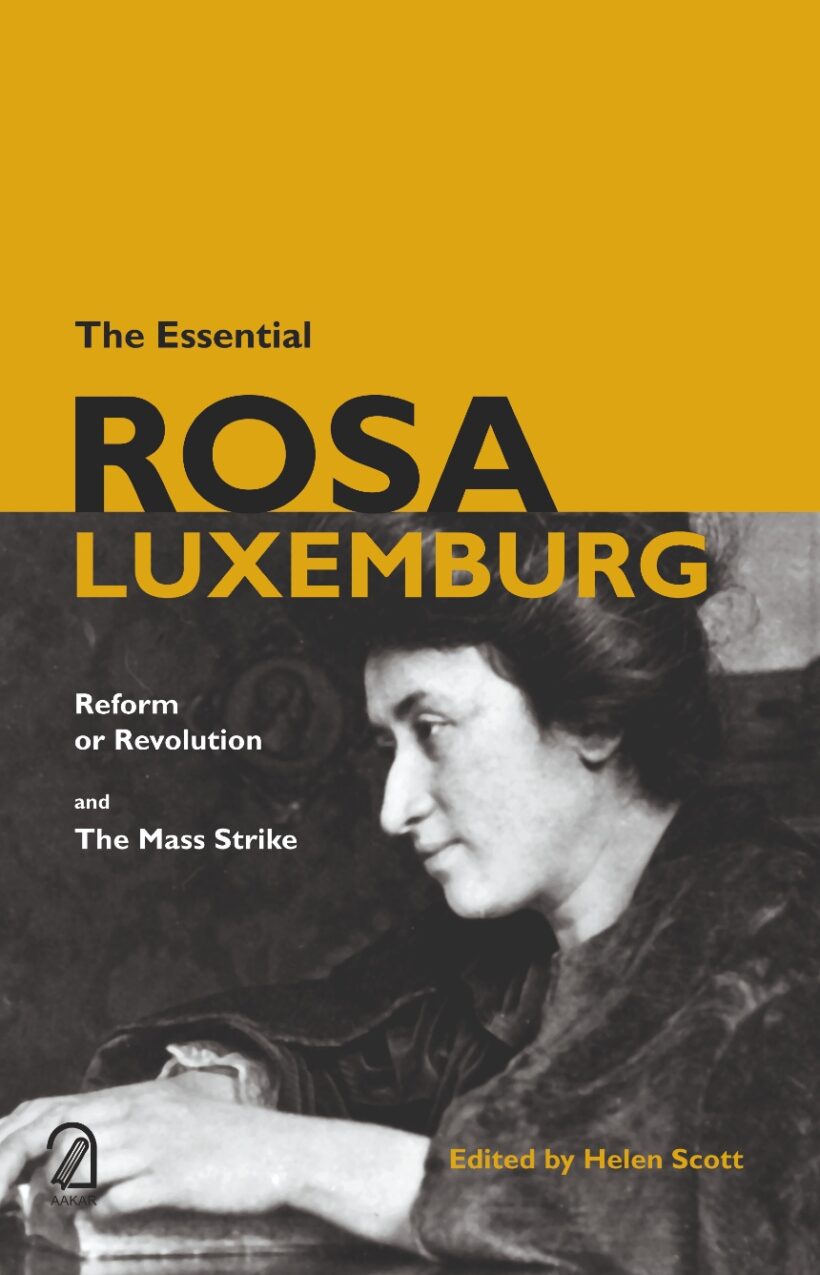
This insightfulnew introduction to Rosa Luxemburg’s two most important works presents the full text of Reform or Revolution and The Mass Strike,with explanatory notes, appendices, and introductions.
One of the most important Marxist thinkers and leaders of the twentieth century, Rosa Luxemburg is finding renewed interest among a new generation of activists and critics of global capitalism.
Related products

Poems selected and translated from Marathi by Dilip Chitre
Namdeo Dhasal tr. Dilip Chitre
‘This is Mumbai without her makeup, her botox, her power yoga; the Mumbai that seethes, unruly, menacing, yet vitally alive’—The Hindu
‘This elegant book is a journey through the bowels of those quarters over which we have constructed robust mental flyovers’—The Sunday Times of India
‘Chitre succeeds in reproducing the images and metaphors of Dhasal’s work, and his unmistakable, hard-hitting voice’—Outlook
‘Dhasal employs an aesthetic of fracture… towards writing into existence the continuing alienation of dalits seduced by the shiny assurances of a still-new nation’—Biblio: A Review of Books

The Motorcycle Diaries is a story which revolves around 2 men who embark on a road journey on a 1939 Norton 500cc cylinder motorcycle from Buenos Aires. They are out to discover and explore South America. This book had been written 8 years prior to the Cuban Revolution. The person who wrote the memoirs of this journey was one of those 2 bikers, Ernesto Guevara. He focused on the injustices that were prevalent at that time in South America.

Choudhury, here, reignites the debate over the appropriation of Ambedkar. Amidst rising echoes for Ambedkar-Marx, Ambedkar-Marx-Bhagat Singh, Ambedkar-Marx-Gandhi-Bhagat Singh, he provocatively asks us to think of Ambedkar’s singular exceptionality—from an excerpt in Indian Cultural Forum
What is most interesting about this difficult but beautiful book is that it is committed to the task of exposing the naked antagonisms that snake across the cracked surfaces of these oppressive structures. —Scroll.in
Nowadays when Ambedkar scholarship has become an industry, Choudhury’s thesis approaches him from an entirely new perspective.—The Telegraph

Stretcher-Bearer of Empire
In the pantheon of global liberation heroes, Mohandas Karamchand Gandhi has pride of place. Leaders like Mandela have lauded him as being part of the epic battle to defeat the white regime and prepare the way for a non-racial country. A popular sentiment in South Africa goes: ‘India gave us Mohandas, and we returned him to you as Mahatma’.
Against this background, The South African Gandhi: Stretcher-Bearer of Empire unravels the complex story of a man who, throughout his stay on African soil (1893–1914), remained true to Empire while expressing disdain for Africans. For Gandhi, whites and Indians were bound by an Aryan bloodline that had no place for the African. His racism was matched by his class (and caste) prejudice towards the Indian indentured. He persistently claimed that they were ignorant and needed his leadership, and wrote their struggles out of history—struggles this book documents.
The authors show that Gandhi never missed an opportunity to demonstrate his loyalty to Empire, with a particular penchant for war. He served as stretcher-bearer in the war between Brit and Boer, demanded that Indians be allowed to carry fire-arms, and recruited volunteers for the imperial army in both England and India during the First World War.
Ashwin Desai is Professor of Sociology at the University of Johannesburg. His previous books include South Africa: Still Revolting, ‘We are the Poors’: Community Struggles in Post-Apartheid South Africa and Reading Revolution: Shakespeare on Robben Island among others.
Goolam Vahed is Associate Professor of History at the University of KwaZulu Natal. He writes on histories of migration, ethnicity, religion, and identity formation among Indian South Africans.
Reviews
There are no reviews yet.