
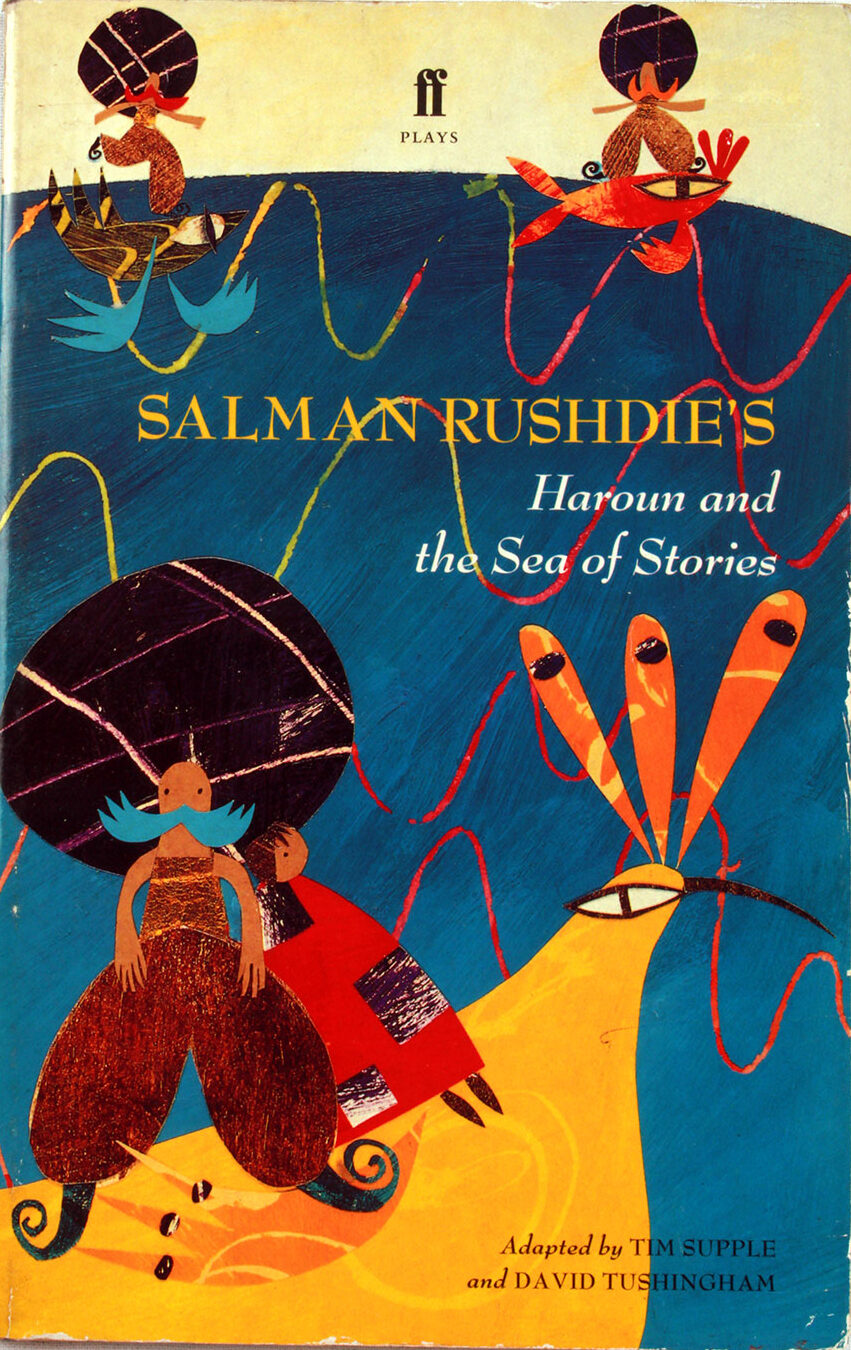
Haroun And The Sea Of Stories | Salman Rushdie
₨ 535.00
Set in an exotic Eastern landscape peopled by magicians and fantastic talking animals, Salman Rushdie’s classic children’s novel Haroun and the Sea of Stories inhabits the same imaginative space as The Lord of the Rings, The Alchemist, and The Wizard of Oz. In this captivating work of fantasy from the author of Midnight’s Children and The Enchantress of Florence, Haroun sets out on an adventure to restore the poisoned source of the sea of stories. On the way, he encounters many foes, all intent on draining the sea of all its storytelling powers.
“Though there is darkness and silence at the center of Chup, most of Haroun and the Sea of Stories is full of comic energy and lively verbal invention. . . .Though [the book] is sure to be enjoyed by children, it also contains amusements for adults.” — The New York Times
1 in stock
Set in an exotic Eastern landscape peopled by magicians and fantastic talking animals, Salman Rushdie’s classic children’s novel Haroun and the Sea of Stories inhabits the same imaginative space as The Lord of the Rings, The Alchemist, and The Wizard of Oz. In this captivating work of fantasy from the author of Midnight’s Children and The Enchantress of Florence, Haroun sets out on an adventure to restore the poisoned source of the sea of stories. On the way, he encounters many foes, all intent on draining the sea of all its storytelling powers.
“Though there is darkness and silence at the center of Chup, most of Haroun and the Sea of Stories is full of comic energy and lively verbal invention. . . .Though [the book] is sure to be enjoyed by children, it also contains amusements for adults.” — The New York Times
Related products

Trotsky’s theory of the permanent revolution is one of the most important additions to the arsenal of marxism. It was first developed by Trotsky in 1904, on the eve of the first Russian Revolution. At that time, all the tendencies of the Russian Social Democracy had the perspective of a bourgeois democratic revolution. Trotsky alone in 1905 put forward the idea that the Russian working class could come to power before the workers of Western Europe. The correctness of Trotsky’s theory was brilliantly demonstrated in 1917, when the Bolshevik Party under Lenin and Trotsky led the Russian proletariat to power in the first workers state in the world.
However, after the death of Lenin in 1924, the theory of the permanent revolution was subject to a vitriolic onslaught by the stalinist bureaucracy, which had in effect renounced world revolution in favour of “socialism in one country”. The attack on the theory came to epitomise the struggle against “Trotskyism”. Today, however, with the collapse of Stalinism (and with it “socialism in one country”), Trotsky’s theory of the permanent revolution has become more relevant than ever.
Publisher : Aakar Publications

Stretcher-Bearer of Empire
In the pantheon of global liberation heroes, Mohandas Karamchand Gandhi has pride of place. Leaders like Mandela have lauded him as being part of the epic battle to defeat the white regime and prepare the way for a non-racial country. A popular sentiment in South Africa goes: ‘India gave us Mohandas, and we returned him to you as Mahatma’.
Against this background, The South African Gandhi: Stretcher-Bearer of Empire unravels the complex story of a man who, throughout his stay on African soil (1893–1914), remained true to Empire while expressing disdain for Africans. For Gandhi, whites and Indians were bound by an Aryan bloodline that had no place for the African. His racism was matched by his class (and caste) prejudice towards the Indian indentured. He persistently claimed that they were ignorant and needed his leadership, and wrote their struggles out of history—struggles this book documents.
The authors show that Gandhi never missed an opportunity to demonstrate his loyalty to Empire, with a particular penchant for war. He served as stretcher-bearer in the war between Brit and Boer, demanded that Indians be allowed to carry fire-arms, and recruited volunteers for the imperial army in both England and India during the First World War.
Ashwin Desai is Professor of Sociology at the University of Johannesburg. His previous books include South Africa: Still Revolting, ‘We are the Poors’: Community Struggles in Post-Apartheid South Africa and Reading Revolution: Shakespeare on Robben Island among others.
Goolam Vahed is Associate Professor of History at the University of KwaZulu Natal. He writes on histories of migration, ethnicity, religion, and identity formation among Indian South Africans.

This Ideas Of Lenin And Trotsky Are Without Doubt The Most Distorted And Slandered In Histoy. For More Than Eighty Years, They Have Been Subjected To An Onslaught From The Apolgists Of Capitalism, Who Have Attempted To Present Their Ideas – Bolshevism – As Both Totalitarian An Utopian. An Entire Industry Was Developed In An Attempt To Equate The Crimes Of Stalinism With The Regime Of Workers’ Democracy That Existed Under Lenin And Trotsky.
Authors : Alan Woods, Ted Grant
Publisher : Aakar Publications

Jotiba Phule’s Fight for Liberty
Story: Srividya Natarajan
Art: Aparajita Ninan
In 1873, Jotirao Govindrao Phule wrote Gulamgiri (Slavery), a scathing, witty attack on the Vedas as idle fantasies of the brahman mind which enslaved the shudras and atishudras. A hundred and forty years hence, Srividya Natarajan and Aparajita Ninan breathe fresh life into Phule’s graphic imagination, weaving in the story of Savitribai, Jotiba’s partner in his struggles.
In today’s climate of intolerance, here’s a manifesto of resistance—Phule setting the dynamite of thought to the scriptures and ideas Hindus hold dear.
Reviews
There are no reviews yet.