
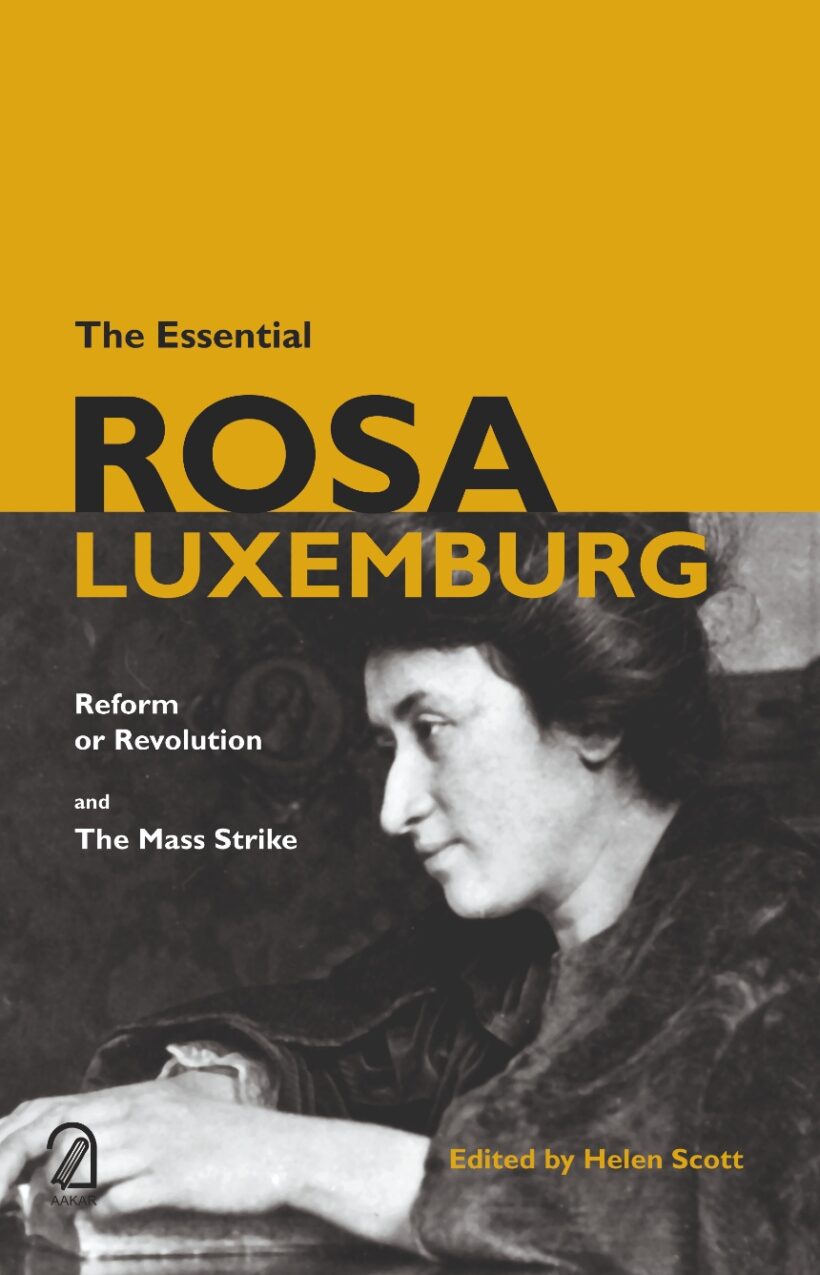
This insightfulnew introduction to Rosa Luxemburg’s two most important works presents the full text of Reform or Revolution and The Mass Strike,with explanatory notes, appendices, and introductions.
One of the most important Marxist thinkers and leaders of the twentieth century, Rosa Luxemburg is finding renewed interest among a new generation of activists and critics of global capitalism.
Related products

Translated from the Hindi by Madhu Singh With a foreword by Angela Y. Davis
September 1970. Ramchandra Singh enters the Hardoi District Jail in Uttar Pradesh as a naxalite undertrial. Barely twenty, his life of expanding prospects—in studies, politics and love—is reduced to the horizon of a life term. The odds are stacked against the survival of his humanity and imagination, but Singh regenerates his gifts of empathy, humour, reflection and, above all, language—in a secret diary smuggled out with the help of friends.
A singular record of recent history and of individual witness, Singh’s prison diary, newly expanded, appears in English for the first time. Offering unprecedented intimacy with the everyday life of the imprisoned everyman, Singh challenges us to look without flinching and question our assumptions about crime and punishment.
Ramchandra Singh (1949–2018), of Bangarmau village in Unnao district of Uttar Pradesh, was a member of the Communist Party of India (Marxist–Leninist) Red Star, and served on its Central Committee. He was part of the editorial board of Red Star Monthly (Hindi). He passed away when this book was in press.
Madhu Singh is a professor in the Department of English and Modern European Languages, University of Lucknow. She has previously translated the scholar G.N. Devy’s work, A Nomad Called Thief, into Hindi as Ghumantu Hain Chor Nahin.

In Marxism and Philosophy Korsch argues for a reexamination of the relationship between Marxist theory and bourgeois philosophy, and insists on the centrality of the Hegelian dialectic and a commitment to revolutionary praxis. Although widely attacked in its time, Marxism and Philosophy has attained a place among the most important works of twentieth-century Marxist theory, and continues to merit critical reappraisal from scholars and activists today.
Publisher : Aakar Publications

Trotsky’s theory of the permanent revolution is one of the most important additions to the arsenal of marxism. It was first developed by Trotsky in 1904, on the eve of the first Russian Revolution. At that time, all the tendencies of the Russian Social Democracy had the perspective of a bourgeois democratic revolution. Trotsky alone in 1905 put forward the idea that the Russian working class could come to power before the workers of Western Europe. The correctness of Trotsky’s theory was brilliantly demonstrated in 1917, when the Bolshevik Party under Lenin and Trotsky led the Russian proletariat to power in the first workers state in the world.
However, after the death of Lenin in 1924, the theory of the permanent revolution was subject to a vitriolic onslaught by the stalinist bureaucracy, which had in effect renounced world revolution in favour of “socialism in one country”. The attack on the theory came to epitomise the struggle against “Trotskyism”. Today, however, with the collapse of Stalinism (and with it “socialism in one country”), Trotsky’s theory of the permanent revolution has become more relevant than ever.
Publisher : Aakar Publications

Fanshen: A Documentary of Revolution in a Chinese Village is a 1966 book by William H. Hinton that describes the land-reform campaign during the Chinese Civil War conducted from 1945 to 1948 by the Chinese Communist Party in “Long Bow Village” (the name used in the book for the village of Zhangzhuangcun in Shanxi province). Hinton lived in the village in spring and summer of 1948 and witnessed scenes described in the book and recreates earlier events based on local records and interviews with participants. He explains party strategy to present the campaign’s successes in building a revolutionary consciousness and a power-base among the poor peasants, but also its errors and excesses, especially the violence toward rich peasants and landlords. Fanshen has been compared to Edgar Snow’s Red Star Over China and characterized as “perhaps the book that most changed American cold war perceptions of the Chinese Revolution.”
Originally published: 1966
Author: William H. Hinton
Reviews
There are no reviews yet.