
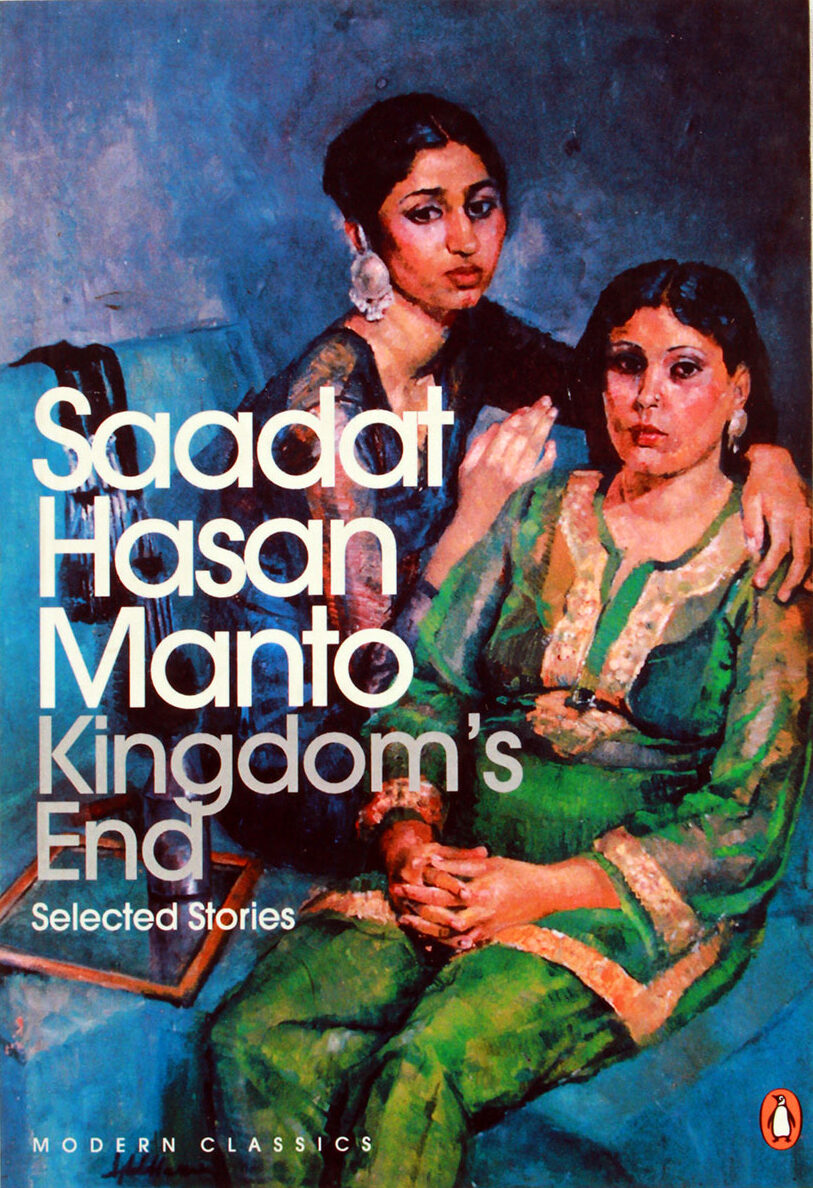
Kingdom’s End: Selected Stories | Saadat Hasan Manto
₨ 638.40
This collection brings together some of Manto’s finest stories, ranging from his chilling recounting of the horrors of Partition to his portrayal of the underworld. Writing with great feeling and empathy about the fallen and the rejects of society, Manto the supreme humanist shows how the essential goodness of people does not die even in the face of unimaginable suffering. Powerful and deeply moving, these stories remain as relevant today as they were first published more than half a century ago.
Out of stock
The most widely read and the most translated writer in Urdu. Saadat Hasan Manto (1912-1955) is also the most controversial: he was tried for obscenity no less than six times, both before and after the departure of the British from India in 1947. In a writing career spanning over two decades, Manto, one of Urdu’s great stylists, produced a powerful and original body of work including short stories, a novel, radio plays, essays and film scripts.
This collection brings together some of Manto’s finest stories, ranging from his chilling recounting of the horrors of Partition to his portrayal of the underworld. Writing with great feeling and empathy about the fallen and the rejects of society, Manto the supreme humanist shows how the essential goodness of people does not die even in the face of unimaginable suffering. Powerful and deeply moving, these stories remain as relevant today as they were first published more than half a century ago.
Related products

This book made history. It wasn’t banned, not quite, when it first appeared in 1984, but its disappearance was cleverly managed so that few got to read the only authentic account of how a protected kingdom became India’s twenty-second state. As the Hon. David Astor, editor of The Observer in London, wrote, Sunanda K. Datta-Ray was ‘alone in witnessing and communicating the essential story’. He had to surmount many obstacles and incur severe disapproval to do so. Nearly thirty years later, a revised edition with the author’s long new introduction reads like an exciting thriller. Rich with dances and durbars, lamaist rituals, intrigue and espionage, it brings vividly to life the dramatis personae of this Himalayan drama—Sikkim’s sad last king, Chogyal Palden Thondup Namgyal, and his vivacious American queen, Hope Cooke; bumbling Kazi Lendhup Dorji and his scheming Kazini, whose nationality and even her name were shrouded in mystery, and who played into the hands of more powerful strategists. Citing documents that have not been seen by any other writer, the book analyses law and politics with masterly skill to recreate the Sikkim saga against the background of a twentieth-century Great Game involving India and China. Smash and Grab: Annexation of Sikkim didn’t only make history. It is history.

This book is correctly regarded as one of Trotsky’s finest classics. It is a product of a sharp polemic within the American trotskyist movement during the period 1939-40. This was a dispute which touched on the very fundamentals of Marxism. It was for this reason that Trotsky himself participated in this struggle in the form of a series of articles and letters that are brought together in this volume.
Publisher : Aakar Publications

Translated from the Hindi by Madhu Singh With a foreword by Angela Y. Davis
September 1970. Ramchandra Singh enters the Hardoi District Jail in Uttar Pradesh as a naxalite undertrial. Barely twenty, his life of expanding prospects—in studies, politics and love—is reduced to the horizon of a life term. The odds are stacked against the survival of his humanity and imagination, but Singh regenerates his gifts of empathy, humour, reflection and, above all, language—in a secret diary smuggled out with the help of friends.
A singular record of recent history and of individual witness, Singh’s prison diary, newly expanded, appears in English for the first time. Offering unprecedented intimacy with the everyday life of the imprisoned everyman, Singh challenges us to look without flinching and question our assumptions about crime and punishment.
Ramchandra Singh (1949–2018), of Bangarmau village in Unnao district of Uttar Pradesh, was a member of the Communist Party of India (Marxist–Leninist) Red Star, and served on its Central Committee. He was part of the editorial board of Red Star Monthly (Hindi). He passed away when this book was in press.
Madhu Singh is a professor in the Department of English and Modern European Languages, University of Lucknow. She has previously translated the scholar G.N. Devy’s work, A Nomad Called Thief, into Hindi as Ghumantu Hain Chor Nahin.

The Making of Babasaheb and the Dalit Movement
Reviews
There are no reviews yet.