
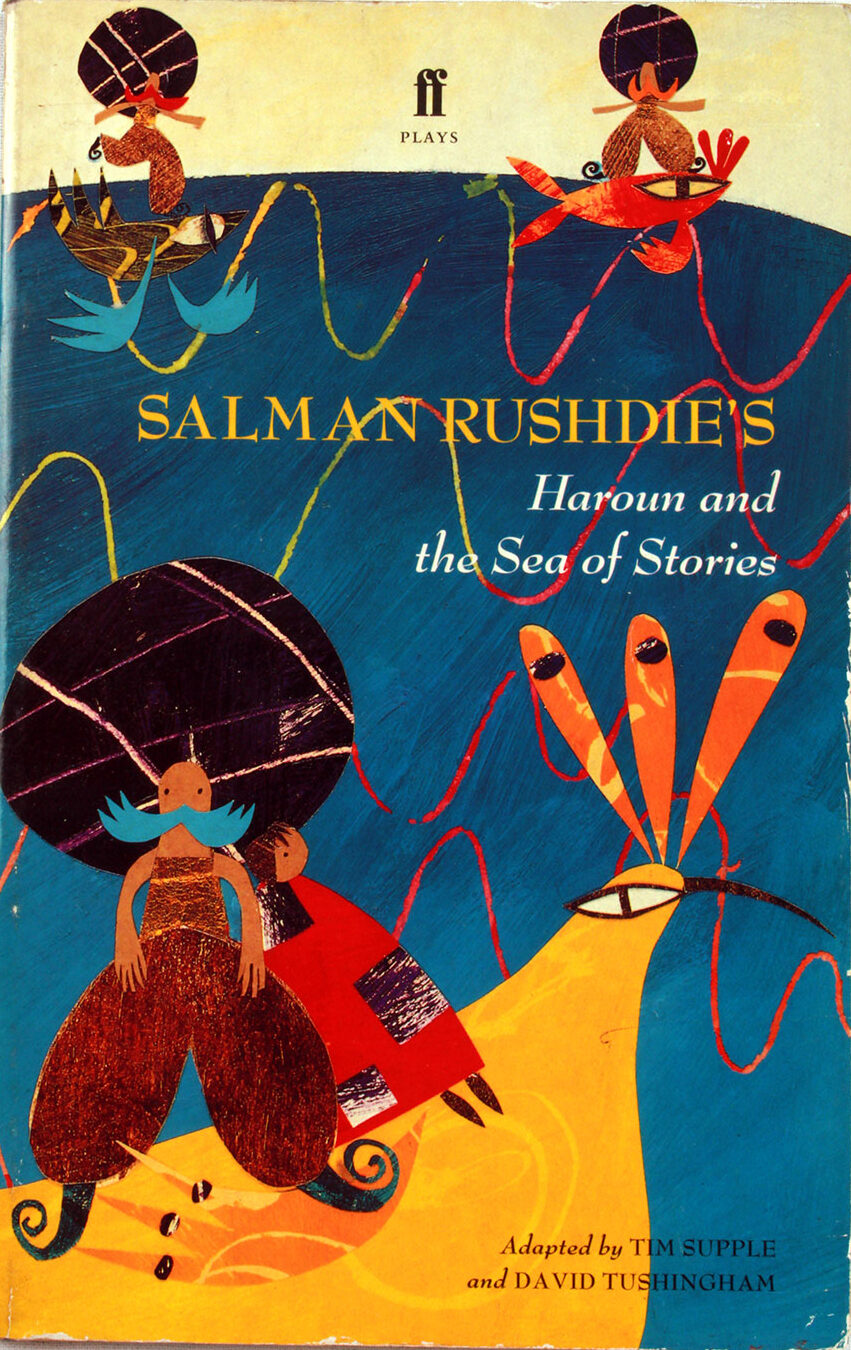
Haroun And The Sea Of Stories | Salman Rushdie
₨ 535.00
Set in an exotic Eastern landscape peopled by magicians and fantastic talking animals, Salman Rushdie’s classic children’s novel Haroun and the Sea of Stories inhabits the same imaginative space as The Lord of the Rings, The Alchemist, and The Wizard of Oz. In this captivating work of fantasy from the author of Midnight’s Children and The Enchantress of Florence, Haroun sets out on an adventure to restore the poisoned source of the sea of stories. On the way, he encounters many foes, all intent on draining the sea of all its storytelling powers.
“Though there is darkness and silence at the center of Chup, most of Haroun and the Sea of Stories is full of comic energy and lively verbal invention. . . .Though [the book] is sure to be enjoyed by children, it also contains amusements for adults.” — The New York Times
1 in stock
Set in an exotic Eastern landscape peopled by magicians and fantastic talking animals, Salman Rushdie’s classic children’s novel Haroun and the Sea of Stories inhabits the same imaginative space as The Lord of the Rings, The Alchemist, and The Wizard of Oz. In this captivating work of fantasy from the author of Midnight’s Children and The Enchantress of Florence, Haroun sets out on an adventure to restore the poisoned source of the sea of stories. On the way, he encounters many foes, all intent on draining the sea of all its storytelling powers.
“Though there is darkness and silence at the center of Chup, most of Haroun and the Sea of Stories is full of comic energy and lively verbal invention. . . .Though [the book] is sure to be enjoyed by children, it also contains amusements for adults.” — The New York Times
Related products

The Ambedkar Cartoons, 1932–1956
Unnamati Syama Sundar with a Foreword by Suraj Yengde
This history like no other asks you to consider what you are laughing at.
In 2012, the inclusion of a 1949 cartoon by Shankar showing Jawaharlal Nehru whipping a snail-borne B.R. Ambedkar in a school textbook, evoked dalit protest, and a savarna counter on the grounds of artistic freedom. Scholar and cartoonist Unnamati Syama Sundar then undertook an archival survey of cartoons on Ambedkar in the English language press. The result, a collection of over a hundred cartoons from India’s leading publications, drawn by Shankar, Enver Ahmed and R.K. Laxman, among others, lays bare the perverse and thoughtless hostility Ambedkar often contended with. The incisional commentary woven around each cartoon offers a veritable biography of a man historically wronged.
Unnamati Syama Sundar grew up in Vijayawada on a diet of Calvin and Hobbes, Dennis the Menace, Chacha Chaudhary and Amar Chitra Katha. He is doing his doctoral research at Jawaharlal Nehru University on the art featured in Chandamama, the popular Telugu children’s magazine founded in 1947. Syama Sundar is well-known for his Ambedkarite cartoons in the non-savarna social media world. His work is featured regularly on the website roundtableindia.co.in.

Jotiba Phule’s Fight for Liberty
Story: Srividya Natarajan
Art: Aparajita Ninan
In 1873, Jotirao Govindrao Phule wrote Gulamgiri (Slavery), a scathing, witty attack on the Vedas as idle fantasies of the brahman mind which enslaved the shudras and atishudras. A hundred and forty years hence, Srividya Natarajan and Aparajita Ninan breathe fresh life into Phule’s graphic imagination, weaving in the story of Savitribai, Jotiba’s partner in his struggles.
In today’s climate of intolerance, here’s a manifesto of resistance—Phule setting the dynamite of thought to the scriptures and ideas Hindus hold dear.

The Making of Babasaheb and the Dalit Movement

The Motorcycle Diaries is a story which revolves around 2 men who embark on a road journey on a 1939 Norton 500cc cylinder motorcycle from Buenos Aires. They are out to discover and explore South America. This book had been written 8 years prior to the Cuban Revolution. The person who wrote the memoirs of this journey was one of those 2 bikers, Ernesto Guevara. He focused on the injustices that were prevalent at that time in South America.
Reviews
There are no reviews yet.