
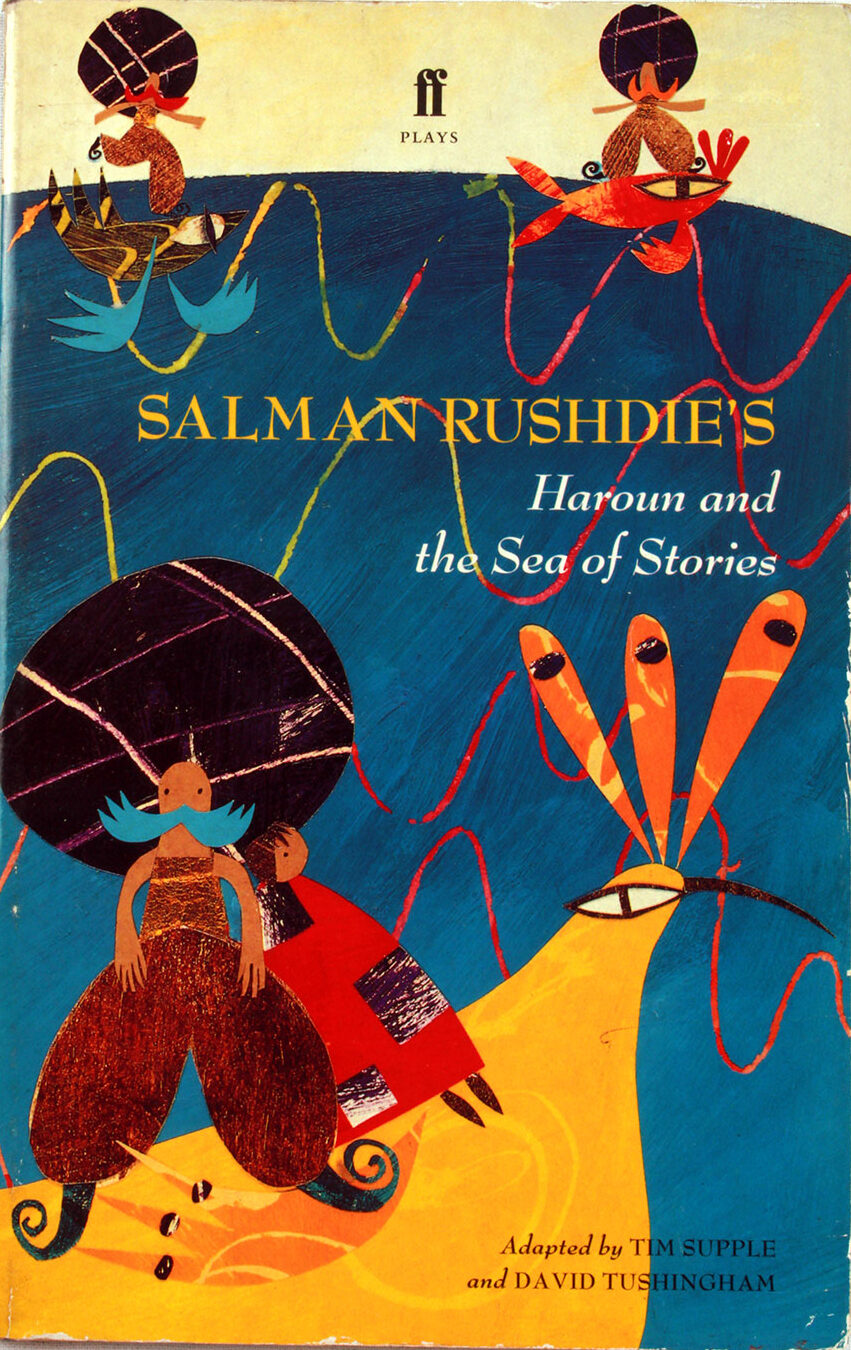
Haroun And The Sea Of Stories | Salman Rushdie
₨ 535.00
Set in an exotic Eastern landscape peopled by magicians and fantastic talking animals, Salman Rushdie’s classic children’s novel Haroun and the Sea of Stories inhabits the same imaginative space as The Lord of the Rings, The Alchemist, and The Wizard of Oz. In this captivating work of fantasy from the author of Midnight’s Children and The Enchantress of Florence, Haroun sets out on an adventure to restore the poisoned source of the sea of stories. On the way, he encounters many foes, all intent on draining the sea of all its storytelling powers.
“Though there is darkness and silence at the center of Chup, most of Haroun and the Sea of Stories is full of comic energy and lively verbal invention. . . .Though [the book] is sure to be enjoyed by children, it also contains amusements for adults.” — The New York Times
1 in stock
Set in an exotic Eastern landscape peopled by magicians and fantastic talking animals, Salman Rushdie’s classic children’s novel Haroun and the Sea of Stories inhabits the same imaginative space as The Lord of the Rings, The Alchemist, and The Wizard of Oz. In this captivating work of fantasy from the author of Midnight’s Children and The Enchantress of Florence, Haroun sets out on an adventure to restore the poisoned source of the sea of stories. On the way, he encounters many foes, all intent on draining the sea of all its storytelling powers.
“Though there is darkness and silence at the center of Chup, most of Haroun and the Sea of Stories is full of comic energy and lively verbal invention. . . .Though [the book] is sure to be enjoyed by children, it also contains amusements for adults.” — The New York Times
Related products

Poems selected and translated from Marathi by Dilip Chitre
Namdeo Dhasal tr. Dilip Chitre
‘This is Mumbai without her makeup, her botox, her power yoga; the Mumbai that seethes, unruly, menacing, yet vitally alive’—The Hindu
‘This elegant book is a journey through the bowels of those quarters over which we have constructed robust mental flyovers’—The Sunday Times of India
‘Chitre succeeds in reproducing the images and metaphors of Dhasal’s work, and his unmistakable, hard-hitting voice’—Outlook
‘Dhasal employs an aesthetic of fracture… towards writing into existence the continuing alienation of dalits seduced by the shiny assurances of a still-new nation’—Biblio: A Review of Books

Translated from the Hindi by Madhu Singh With a foreword by Angela Y. Davis
September 1970. Ramchandra Singh enters the Hardoi District Jail in Uttar Pradesh as a naxalite undertrial. Barely twenty, his life of expanding prospects—in studies, politics and love—is reduced to the horizon of a life term. The odds are stacked against the survival of his humanity and imagination, but Singh regenerates his gifts of empathy, humour, reflection and, above all, language—in a secret diary smuggled out with the help of friends.
A singular record of recent history and of individual witness, Singh’s prison diary, newly expanded, appears in English for the first time. Offering unprecedented intimacy with the everyday life of the imprisoned everyman, Singh challenges us to look without flinching and question our assumptions about crime and punishment.
Ramchandra Singh (1949–2018), of Bangarmau village in Unnao district of Uttar Pradesh, was a member of the Communist Party of India (Marxist–Leninist) Red Star, and served on its Central Committee. He was part of the editorial board of Red Star Monthly (Hindi). He passed away when this book was in press.
Madhu Singh is a professor in the Department of English and Modern European Languages, University of Lucknow. She has previously translated the scholar G.N. Devy’s work, A Nomad Called Thief, into Hindi as Ghumantu Hain Chor Nahin.

The Motorcycle Diaries is a story which revolves around 2 men who embark on a road journey on a 1939 Norton 500cc cylinder motorcycle from Buenos Aires. They are out to discover and explore South America. This book had been written 8 years prior to the Cuban Revolution. The person who wrote the memoirs of this journey was one of those 2 bikers, Ernesto Guevara. He focused on the injustices that were prevalent at that time in South America.

This book made history. It wasn’t banned, not quite, when it first appeared in 1984, but its disappearance was cleverly managed so that few got to read the only authentic account of how a protected kingdom became India’s twenty-second state. As the Hon. David Astor, editor of The Observer in London, wrote, Sunanda K. Datta-Ray was ‘alone in witnessing and communicating the essential story’. He had to surmount many obstacles and incur severe disapproval to do so. Nearly thirty years later, a revised edition with the author’s long new introduction reads like an exciting thriller. Rich with dances and durbars, lamaist rituals, intrigue and espionage, it brings vividly to life the dramatis personae of this Himalayan drama—Sikkim’s sad last king, Chogyal Palden Thondup Namgyal, and his vivacious American queen, Hope Cooke; bumbling Kazi Lendhup Dorji and his scheming Kazini, whose nationality and even her name were shrouded in mystery, and who played into the hands of more powerful strategists. Citing documents that have not been seen by any other writer, the book analyses law and politics with masterly skill to recreate the Sikkim saga against the background of a twentieth-century Great Game involving India and China. Smash and Grab: Annexation of Sikkim didn’t only make history. It is history.
Reviews
There are no reviews yet.